
The Eastern Suburbs Eruv now extends to Maroubra, making it easier to carry and push prams on Shabbat.
To check if the eruv is up, call after 4pm just before Shabbat or festival days.
To receive a weekly SMS confirming the eruv is kosher, ask to join the eruv update list by calling the KA on 9365 2933 or emailing office@ka.org.au.
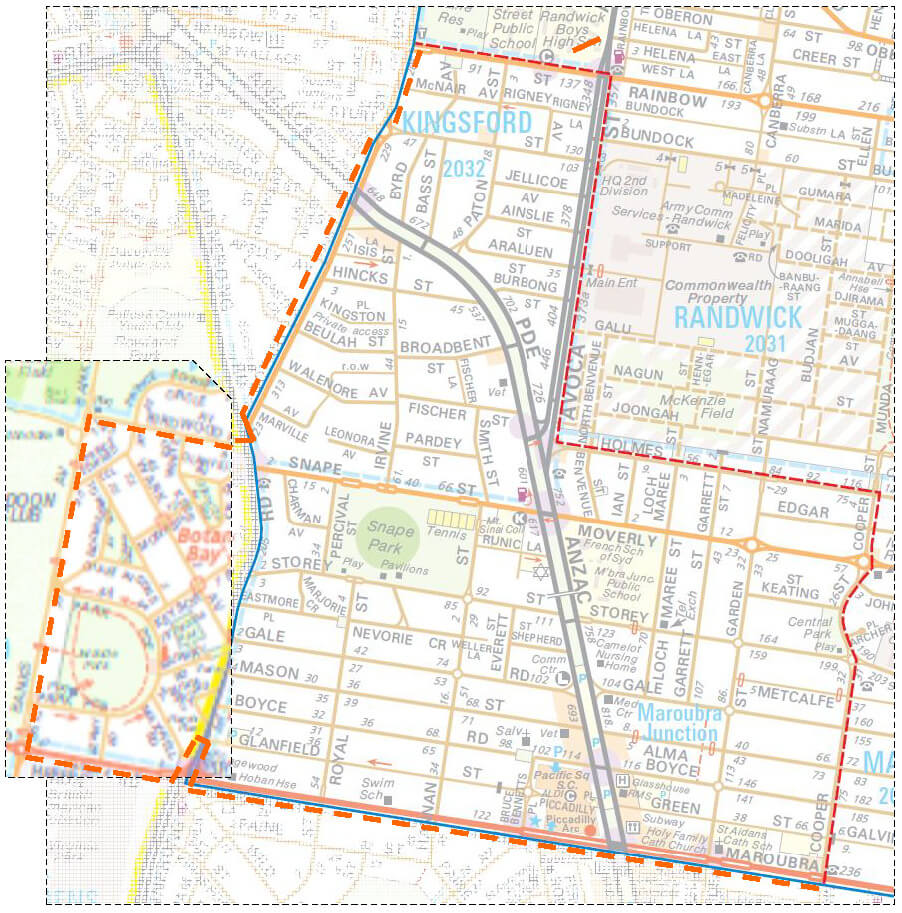
Map of the eruv extension in Maroubra. Click to enlarge.
In short, an eruv creates a private domain for halachic purposes.
Halacha prohibits work on Shabbat. Moving items between a private domain and a public domain, or within the public domain, is included in the category of ‘work’ and is prohibited. This includes pushing a pram in the street or carrying keys in your pocket. Carrying within a private domain, however, is permitted, and in certain circumstances an area can be given the status of a private domain.
The full name for the eruv is eruv chatzeirot, meaning the mixing of courtyards. An eruv is an enclosure (of sorts) surrounding both private and public domains, creating one large private domain in which carrying is permitted on Shabbat. In theory an eruv is a solid wall, like the walled Old City of Jerusalem. In practice, our ‘wall’ is made up of hundreds of ‘gates’: conduits on either side of existing cables form the doorposts, and the cables strung between the poles act as the lintel. Natural boundaries, such as the cliffs off Coogee Beach and fences, complete the enclosure.
For an eruv to be kosher, the community must also symbolically share food. Communal matzah, which lasts a long time, is kept at Coogee Synagogue. It symbolises that everyone within the eruv shares food and lives together in one ‘private’ domain. A blessing is also said at the inauguration of the eruv.
An eruv does not permit carrying objects whose use is forbidden on Shabbat. For example, an umbrella cannot be carried anywhere on Shabbat, and phones or wallets cannot be carried within the eruv. The eruv allows Shabbat necessities to be carried, such as a tallit or siddur, house keys, clothing removed on warm days and reading glasses, as well as pushing a pram with food and nappies.
The eruv is checked every week and any breaks are repaired before Shabbat; otherwise it may not be kosher. The levy raised by Maroubra and Coogee shuls pays for qualified checkers and drivers to check the route each week, and for tradespeople to carry out repairs.
Our eruv connects to the existing Bondi Eruv. For full maps and details of the wider Sydney eruv, visit the Sydney Eruv website, or learn more about the eruv on Chabad.org.
Whether you have a question for the Rabbi, would like to join our community or simply want to know more, send us a message and we will get back to you.